
Racehorse Ownership Glossary: Racing Terms Explained
The Short Answer
Racing has a lot of jargon. This glossary explains 58 terms you'll meet as a syndicate or club member, in plain English, with links to the guide that covers each one in more depth.
Free PDF Guide + Weekly Email
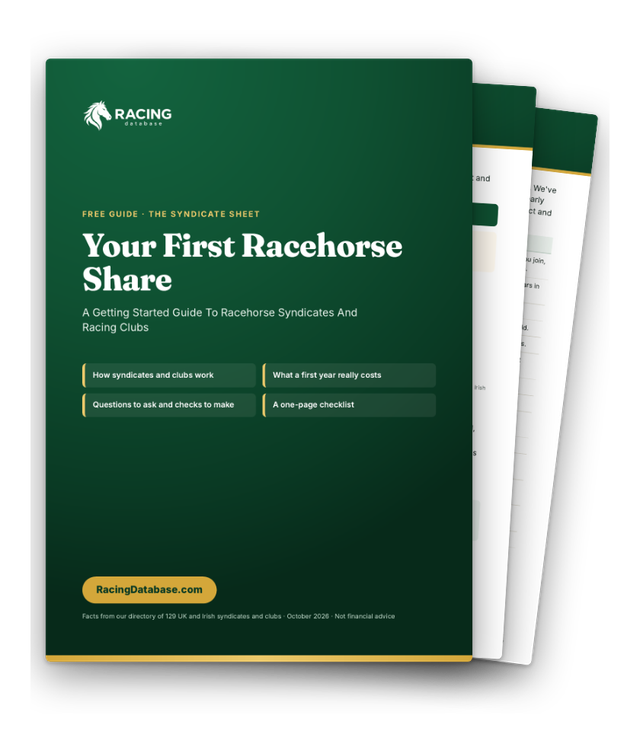
Your First Racehorse Share
Get our free 14-page getting started guide to racehorse syndicates and racing clubs, plus The Syndicate Sheet every Thursday: new shares, price changes and the week's syndicate winners.Free 14-page guide plus The Syndicate Sheet every Thursday.
Free. We'll ask you to confirm your email, then your guide is on its way. See what's inside
A
- All-weather
- A synthetic racing surface used all year, especially in winter. Flat racing only.
- Permission an owner gives someone, usually the trainer, to make entries and handle racing admin on their behalf.
B
- BHA
- The British Horseracing Authority, which governs and regulates racing in Britain and licenses syndicators and club managers. See rules and licensing.
- Box rest
- Time an injured horse spends confined to its stable while it recovers.
- Breeze-up
- An auction of two-year-olds who gallop in front of buyers before the sale. See how racehorses are bought.
- Bumper
- A National Hunt Flat race: a race without obstacles for young jumps horses, to give them experience.
C
- Chase (steeplechase)
- A jumps race over larger, fixed fences.
- Claiming race
- A race in which any runner can be bought (claimed) afterwards for a set price.
- Class
- The level of a race in Britain, from Class 1 (the best) downwards. See race types.
- Colours (silks)
- The jockey's jacket and cap in the owner's registered design. See racing colours.
- Colt
- A male horse aged four or under that hasn't been gelded.
- Connections
- Everyone linked to a horse on race day: owners, trainer and jockey.
D
- Declaration
- Confirmation, usually a day or two before a race, that a horse will run and who will ride it.
E
- Entry
- Putting a horse's name forward for a race, days before declarations. Entry fees apply.
F
- Filly
- A female horse aged four or under.
- First-year cost
- Our estimate of the upfront price plus 12 months of fees for one share. See how we calculate it.
- Flat
- Racing without obstacles. See Flat or Jumps.
G
- Gallops
- The training tracks where horses do their work, often shared at training centres.
- Gelding
- A castrated male horse. Many jumps horses are geldings.
- Going
- The condition of the ground, from heavy (very soft) to firm.
- Group race
- The top level of Flat racing, Group 1 to Group 3. Over jumps, the top races are Grades.
H
- Handicap
- A race where weights are set by official ratings to give every runner an equal chance. See ratings and handicaps.
- HRI
- Horse Racing Ireland, which runs Irish racing and registers owners, syndicates and clubs. See Ireland.
- Hunter Certificate
- The yearly certificate that qualifies a horse to run in point-to-points. See point-to-point ownership.
- Hurdle
- A jumps race over smaller obstacles than fences. Most jumpers hurdle before they chase.
I
- IHRB
- The Irish Horseracing Regulatory Board, which writes and enforces the Rules of Racing in Ireland.
J
- Juvenile
- A two-year-old on the Flat. Over jumps, juvenile hurdles are for the youngest hurdlers.
L
- Lease
- An agreement to race a horse you don't own for a set period. See lease vs buy.
- Listed race
- A race just below Group or Grade level.
M
- Maiden
- A horse that hasn't won a race of a given type, and the races for such horses.
- Mare
- A female horse aged five or over.
N
- National Hunt
- Jump racing: hurdles, chases and bumpers.
- Non-runner
- A horse withdrawn after being declared to run.
- Novice
- A horse early in its career, and races for such horses. The exact definition depends on the code and the race conditions.
- Nursery
- A handicap for two-year-olds on the Flat.
O
- Official rating
- The BHA handicappers' assessment of a horse's ability, in pounds. It decides which handicaps it can enter and the weight it carries.
- Owners' badge
- Free entry to the owners' areas when your horse runs. See owners' badges.
P
- Parade ring
- Where horses are walked before a race and connections meet the jockey. See your first race day.
- Partnership
- Two or more registered owners sharing a horse. See owning with friends.
- Pattern
- The top races collectively: Group and Grade races (with Listed races just below).
- Point-to-point
- Amateur jump racing organised by hunts, under the BHA's point-to-point regulations.
- Premier Handicap
- The name for the big jumps handicaps that used to be Grade 3 races.
- Price per 1%
- What 1% of a horse costs, so shares of different sizes can be compared. See Price Per 1%.
- Prize money
- Money paid to the first few finishers, shared between owners, trainer, jockey and stable staff. See where prize money comes from.
R
- Racing Admin
- The online system British owners and trainers use for entries, names, colours and registrations.
- Racing club
- A membership where you follow the club's horses but don't own them. See syndicate vs racing club.
- ROA
- The Racehorse Owners Association, which represents owners in Britain.
- RSA
- The Racehorse Syndicates Association, a members' trade body for syndicates. It isn't a regulator.
S
- Selling race
- A race whose winner is offered for sale at auction afterwards.
- A percentage of a horse (or of a lease on one) sold to a syndicate member.
- Store
- A young unraced jumps horse bought to be given time to develop.
- Strike rate
- Wins divided by runs, as a percentage.
- Syndicate
- A group sharing a horse, run by a syndicator. See how syndicates work.
- Syndicator
- The person or company that runs a syndicate. In Britain they need a BHA licence if the syndicate is advertised or they're paid to run it.
T
- Trip
- The distance of a race.
V
- VAT scheme
- HMRC's registration scheme for racehorse owners, which lets qualifying owners reclaim some VAT. See tax and VAT.
W
- Weatherbys
- The company that administers British racing for the BHA, including names, colours and the Racing Calendar Office.
Y
- Yearling
- A horse in its second calendar year, from 1 January after it was foaled until the next 31 December.
Our own plain-English definitions, written for owners rather than as legal definitions. For the official wording, see the BHA Rules of Racing. Missing a term? Tell us.
General information from published prices and terms, not financial advice. Racehorse ownership is a hobby, not an investment. Always read the syndicate agreement before paying anything. Spotted something out of date? Tell us.