
Racehorse Ownership, Tax And VAT: A Plain-English Guide
The Short Answer
For a typical syndicate or club member in the UK, there's usually nothing to do. HMRC treats owning and racing horses as a hobby, so prize money isn't taxed as trading income and the costs can't be claimed against tax. A gain on selling a racehorse is usually outside capital gains tax. VAT is different: HMRC runs a special scheme that lets qualifying owners, including syndicates, register and reclaim some VAT, but an individual needs at least 50% of a horse to register alone.
This is general information from HMRC, BHA and Horse Racing Ireland guidance, not tax advice. Rules change and your own circumstances matter, so check with HMRC or a qualified adviser.
Free PDF Guide + Weekly Email
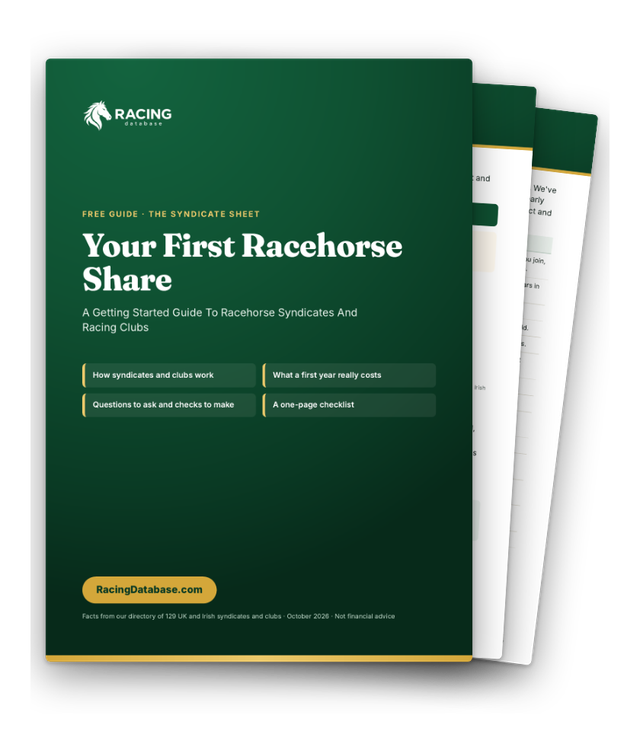
Your First Racehorse Share
Get our free 14-page getting started guide to racehorse syndicates and racing clubs, plus The Syndicate Sheet every Thursday: new shares, price changes and the week's syndicate winners.Free 14-page guide plus The Syndicate Sheet every Thursday.
Free. We'll ask you to confirm your email, then your guide is on its way. See what's inside
Why Racing Is Usually A Hobby For Tax
HMRC's Business Income Manual says plainly that horse racing "is not a taxable activity" (HMRC BIM55701). In practice, for a typical member:
- Your share of prize money isn't taxed as income from a trade.
- Your fees and racing costs aren't a business expense, so you can't deduct them or claim a loss.
- Hoping to make money doesn't turn a hobby into a trade.
It can be different for people whose racing is part of a business, such as breeders who race horses they've bred, dealers, trainers, or a company using a horse to advertise. HMRC's manual notes that care is needed where a stud farmer also races. If that's you, take advice.
Selling A Horse Or A Share
HMRC's Capital Gains Manual treats all animals as wasting assets, and tangible moveable wasting assets are generally exempt from capital gains tax unless capital allowances were or could have been claimed (HMRC CG76721). In the usual case, that means a gain on a racehorse isn't taxed, and a loss can't be claimed either. Different rules can apply if you hold shares in a company that owns horses rather than an interest in the horse itself.
VAT: The Racehorse Owners' Scheme
Most hobbies can't reclaim VAT. Racing is unusual: under VAT Notice 700/67, HMRC accepts racehorse ownership as a business activity for owners who meet the scheme's conditions, so they can register for VAT and recover some of the VAT they're charged (HMRC VAT Notice 700/67). The key points:
- Who qualifies. A registered owner whose horse is covered by a sponsorship agreement registered at Weatherbys, or a trainer's sponsorship agreement, or who can show ongoing business income from racing, such as appearance money or sponsored number cloths.
- Shares. If you own part of a horse, you can register alone only if you own at least 50% of it; otherwise you can only register as a partnership with the other owners. The BHA adds that the 50% must be of a single horse, not shares added up across several (BHA guide to registering to reclaim VAT).
- Syndicates and clubs are among the owners who can use the scheme, so any VAT registration is normally the syndicate's, not yours.
- What can be reclaimed includes VAT on buying, training and keeping the horse, but not business entertainment such as hospitality.
What It Means For Prices
The same headline price can include VAT or not, depending on how a syndicate or club is set up. A club whose members pay a subscription for benefits, without owning the horses, may be charging VAT on that subscription; a syndicate whose members own the horse may not. In our directory, 5 active listings mention VAT in their published prices or terms: BG Racing Syndicates, Greenall Guerriero Racing, Highclere Racing, Kübler Racing Syndicates, Owners Group. Always ask:
- Does this price include VAT?
- Is the syndicate VAT registered, and if it reclaims VAT, how does that reach members?
- Do statements show amounts with and without VAT?
The BHA's Syndicates Code requires the contract to say when statements of costs will be given, including details of any VAT (Syndicates Code). Our Cost Calculator can add VAT to a price quoted without it.
Ireland
Horse Racing Ireland says prize money is tax free for owners because ownership is a hobby, whereas jockeys and trainers are taxed on their earnings (HRI prize money). Irish VAT works differently from the UK scheme: the standard rate is 23% (Revenue), and we couldn't find an Irish equivalent of HMRC's owners' scheme. If you live in Ireland or join an Irish syndicate, ask an Irish tax adviser. More in racehorse ownership in Ireland.
When To See An Accountant
- You own, or plan to own, 50% or more of a horse, or you're forming a partnership.
- The horse has a sponsor, or you receive racing income other than prize money.
- You breed, train or deal in horses, or a business is involved.
- You're starting or running a syndicate or club yourself.
- Anyone says a share is "tax-efficient". Treat that as a warning sign.
Not Advice
This guide is general information from published rules, prices and official race results, not financial, tax or legal advice. We don't tip horses or recommend a deal. Racehorse ownership is a hobby, not an investment. For tax, always check HMRC's current guidance or ask a qualified adviser.
Sources
- HMRC Business Income Manual BIM55701
- HMRC Capital Gains Manual CG76721
- HMRC VAT Notice 700/67: registration scheme for racehorse owners
- BHA guide to registering to reclaim VAT
- BHA Syndicates Code (15 October 2026 edition, version 2026.4.1)
- Horse Racing Ireland: prize money and Revenue: current VAT rates
- Outside pages read 30 to 31 Oct 2026. VAT mentions: each listing's published terms, checked 19 Oct 2026.
Questions People Ask
Is Racehorse Prize Money Taxable In The UK?
For a typical hobby owner, no. HMRC's manual says horse racing "is not a taxable activity", so prize money isn't taxed as trading income, and costs can't be claimed either (HMRC). It can differ if racing is part of a business.
Can I Reclaim VAT On My Racehorse Syndicate Share?
Not usually in your own name. Under HMRC's racehorse owners' scheme you need at least 50% of a single horse to register alone. A syndicate can register under the scheme, so ask the syndicate whether it does and how any reclaimed VAT is passed on.
Do You Pay Capital Gains Tax When A Racehorse Is Sold?
Usually not. HMRC treats animals as wasting assets, which are generally exempt from capital gains tax unless capital allowances could have been claimed. A loss can't normally be claimed either.
General information from published prices and terms, not financial advice. Racehorse ownership is a hobby, not an investment. Always read the syndicate agreement before paying anything. Spotted something out of date? Tell us.