
Betting Tax Rise: Will Racehorse Shares Get More Expensive?
The Budget raises the tax on betting shop gaming machines from April 2027, and racing says prize money could suffer. What changes, when, and what it could mean for the cost of a syndicate share.
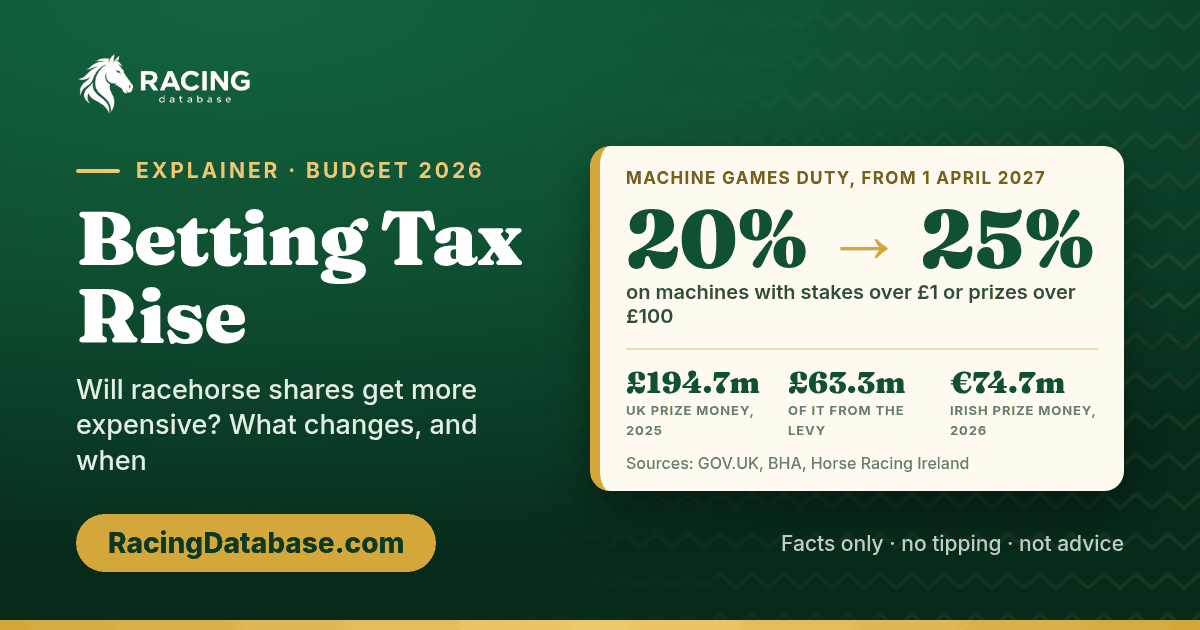
The Budget on 28 October raised the tax on higher-stake gaming machines in betting shops. Racing's governing body says that could close shops and cut the money the sport gets from betting. So will owning a share in a racehorse cost more? Here's what changes, what racing's bodies say, and what we can and can't tell you yet.
The Short Answer
Probably not directly, and not straight away. Syndicate fees pay for training, vets, farriers and transport, and those costs follow the yard's bills, not betting tax. What the tax could affect is prize money, the money that comes back when a horse wins or is placed. If race values fall, members get less back while the fees stay the same. That would make a share cost more overall, even if the price on the website doesn't change.
What Changes And When
| When | What changes | Source |
|---|---|---|
| 1 April 2026 | Remote Gaming Duty (online casino and slots) rose from 21% to 40% | GOV.UK |
| 1 April 2027 | Machine Games Duty rises from 20% to 25% on machines with stakes over £1 or prizes over £100 | GOV.UK |
| 1 April 2027 | A new 25% rate for online betting, but online bets on UK horseracing stay at 15% | GOV.UK |
| 1 April 2027 | National Living Wage rises 3.9% to £13.21 an hour | GOV.UK |
| Date not set | Financial risk checks on the highest-spending gamblers start in stages | Gambling Commission |
The government kept the lower rate for online bets on UK racing because bookmakers already pay racing's 10% Levy on those bets. The Gambling Commission says the first stage of its checks will cover customers of the largest operators with net deposits over £5,000 in 24 hours, and that it will confirm the start date later.
Why Racing Is Worried
Betting shops matter to racing because they pay into the Levy and pay racecourses for live pictures and data.
- The BHA's view. Its chief executive says British racing gets nearly a third of its £350m a year in betting income through high street shops, and that it could lose £57m a year as a result of the duty rise. He says this is based on modelling shared with the Treasury, and warns that "hundreds, if not thousands" of shops could close (Guardian, 28 Oct 2026). These are the BHA's estimates, not official forecasts.
- The other side. The Social Market Foundation, which had called for a much bigger rise, called the increase "relatively limited" (same report). The government expects the change to raise about £130m to £135m a year (GOV.UK).
- The Levy so far. The Levy Board expects about £110m for 2025/26, which it says would be the highest since 2017. It also says it has "significant concern" about falling betting turnover (HBLB).
- Owners. The Racehorse Owners Association says 47% of owners in its survey intend to reduce their investment in the sport over the next three to five years (ROA).
What It Could Mean For Your Share
None of this is certain. These are the ways it could reach syndicate members:
- Less prize money back. About a third of British prize money comes from the Levy Board, the BHA says. If that shrinks, so could race values and your share of any winnings. For most members prize money is a small part of the experience anyway (see can you make money from a syndicate?).
- Fees follow costs, not tax. Staff wages are a big part of a training fee, and the April 2027 wage rise is a more direct pressure on monthly fees than betting duty.
- More shared ownership, or less. If whole-horse owners cut back, trainers may sell more horses in shares. If costs rise, some small syndicates may close. We'll be able to see which way it goes.
- Ireland is different. Irish prize money is mostly government-funded. HRI's 2026 prize money budget is a record €74.7m (HRI), so British shop taxes don't feed into it in the same way.
Our new guide explains every source of prize money in more detail: Where Prize Money Comes From.
What Our Data Can Show (And When)
Our price tracking began in October 2026, from prices checked in the days before the Budget. That gives a clean starting point, but no trend yet:
- £900: the median first-year cost of a share or membership in our October 2026 baseline on the Price Index.
- £62.50: the median monthly fee across the 36 UK listings that publish one.
- £1,183: the median first-year cost per 1% of a horse on Price Per 1%, across 70 sterling shares checked on 29 October.
- 128 shares on sale from 29 syndicates on our Shares For Sale list on 29 October.
We take a new price snapshot every month and check the share list every week. From early 2027 we'll be able to say whether fees and share prices are moving. We don't record prize money won by syndicate horses, so we won't claim anything about it.
If You're Thinking Of Joining
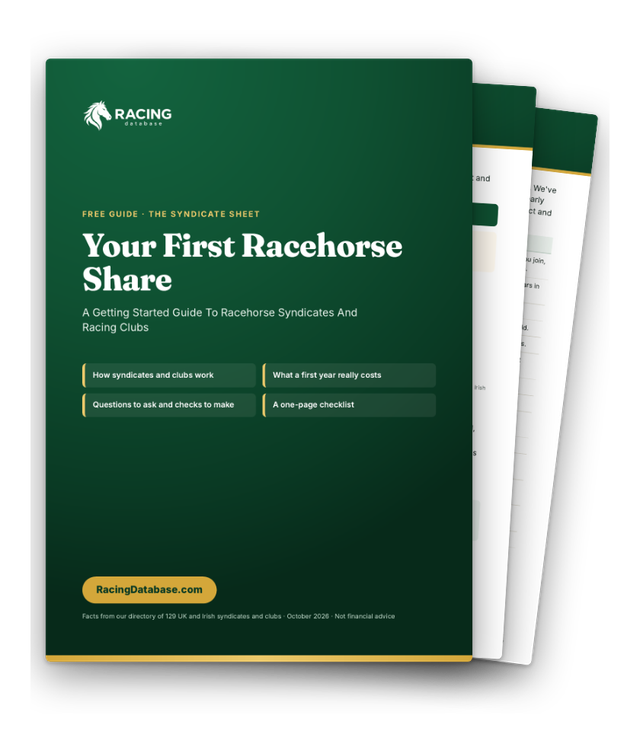
Budget the fees, not the winnings. Look at the cheapest syndicates and the ones with no upfront cost, read what syndicate fees cover, and work out a full year with the cost calculator. Our free 14-page guide, Your First Racehorse Share, takes you through it step by step.
Racehorse ownership is a hobby, not an investment. We don't tip and we don't give financial advice. Figures from the BHA and other bodies are their own estimates.
Free PDF Guide + Weekly Email
Your First Racehorse Share
Get our free 14-page getting started guide to racehorse syndicates and racing clubs, plus The Syndicate Sheet every Thursday: new shares, price changes and the week's syndicate winners.Free 14-page guide plus The Syndicate Sheet every Thursday.
Free. We'll ask you to confirm your email, then your guide is on its way. See what's inside
More News

21 Syndicate Wins This Week, A Group 3 At Dundalk And Four New Irish Listings
Results through 28 Oct: 541 UK and Irish syndicate wins in 2026, Washington Heights' Group 3 at Dundalk, four new Irish listings and 130 shares for sale.
Read More →
Washington Heights Wins The Group 3 Mercury Stakes At Dundalk: Syndicate Winners, 22 To 27 October
Washington Heights won the Group 3 Mercury Stakes at Dundalk for Hambleton Racing and Kevin Ryan, one of 17 wins for 13 listed UK and Irish syndicates between 22 and 27 October 2026.
Read More →
New: Racecourse Pages, Where Syndicate Horses Run And Win
Every UK and Irish racecourse where a syndicate horse ran in 2026 now has a page: the winners, the syndicates, the trainers and every horse that ran there. 83 courses, A to Z.
Read More →General information, not financial advice. Racehorse ownership is a hobby, not an investment. Spotted something out of date? Tell us.